Why Fat Isn't Just Fat – and How Cortisol, Cell Membranes and Diet Quietly Determine Where Your Belly Fat Goes
Many people believe body fat is simply an energy store.
In with it, out with it – calories in, calories out. Done.
Unfortunately, that holds up about as well as the assumption that all cars drive the same way because they have four wheels.
Because fat tissue is highly active, hormonally sensitive – and sometimes downright devious. Particularly when it comes to visceral fat: the fat deep within the abdominal cavity, surrounding the liver, intestines and other organs.
And this is where a hormone we tend to associate purely with stress enters the picture:
Cortisol.
Cortisol: A Stress Hormone With a Double Life
Cortisol has a bad reputation. Undeservedly so – at least in part.
Without cortisol:
🌅
🩸
⚡
But too much cortisol – or cortisol in the wrong place – becomes a problem.
In Cushing's syndrome (pathologically elevated cortisol levels), this becomes extreme:
💪 Muscle loss
Cortisol breaks down muscle tissue, leading to progressive weakness and loss of mass.
🦴 Thin skin & osteoporosis
Connective tissue and bone density deteriorate under chronic cortisol excess.
🫃 Massive increase in belly fat
Simultaneously, visceral fat accumulates dramatically – even as other tissue wastes away.
Paradoxical? Only at first glance.
Why People With High Cortisol Aren't Necessarily "Heavier"
This is where things get interesting – and counterintuitive.
Cortisol acts in a catabolic (breaking-down) way on muscles, bones and connective tissue – whilst simultaneously acting in a lipogenic (fat-building) way on visceral fat.
This means you can lose body weight whilst the most dangerous type of fat is actually increasing.
The scales celebrate – the metabolism does not. This is precisely what tends to happen with most diets. The number on the scales drops, you feel pleased with yourself, but in reality you've lost muscle, bone and connective tissue whilst gaining visceral fat (organ fat).
The Real Trick: Cortisol Acts Locally
Now comes the crucial point that many studies overlooked for a long time:
"It isn't the cortisol in the blood that matters – it's the cortisol in the tissue."
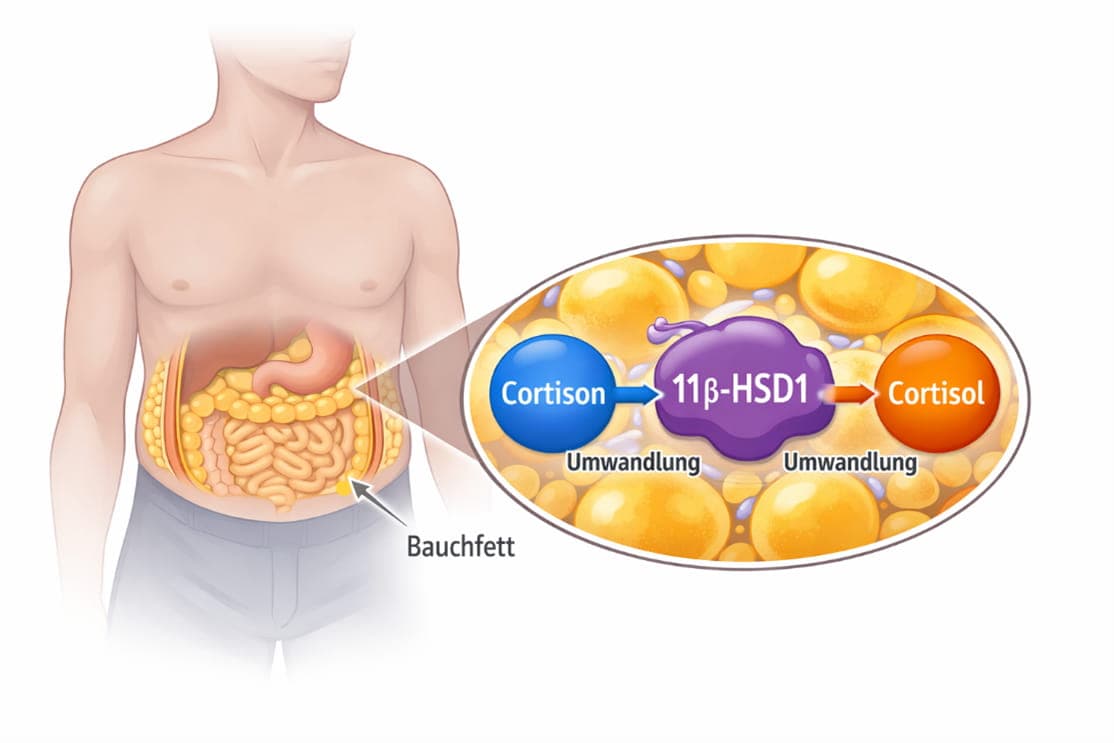
In visceral fat sits an enzyme with the rather unwieldy name:
11β-Hydroxysteroid Dehydrogenase Type 1 (11β-HSD1)
This enzyme does the following:
●
It converts inactive cortisone
●
directly within the fat tissue
●
back into active cortisol
Even at normal or low cortisol levels in the blood, the abdominal fat can be running at full capacity.
Cortisone is the inactive reserve form of cortisol. In a healthy body it exists at lower concentrations, fluctuates throughout the day and serves as a local regulator for stress hormones.
Typical Values
Substance
Range
Cortisone
2–10 nmol/L
Cortisol
1–20 nmol/L (more variable)
Cortisone in the blood typically sits at around 20–40% of the cortisol level. The cortisol/cortisone ratio is regarded as a marker for local 11β-HSD activity.
Studies show that the activity of the enzyme 11β-Hydroxysteroid Dehydrogenase Type 1 (11β-HSD1) – that is, the conversion of inactive cortisone to active cortisol within fat tissue – is associated with visceral fat accumulation and metabolic parameters. This enzyme is more active in visceral fat than in subcutaneous fat, which can lead to locally higher cortisol concentrations, even when circulating cortisol levels are normal.
And Now Nutrition Enters the Picture (Finally!)
The fascinating question is: what controls this enzyme?
A surprising answer from the research:
The fatty acid composition of the cell membranes.
Not how many calories you eat.
Not primarily how much fat you have.
But rather which fatty acids make up the membranes in which this enzyme operates.
Fat Builds Membranes – and Membranes Control Hormones
Cell membranes are composed of phospholipids, which in turn contain fatty acids.
Depending on what you eat, these membranes become either rigid or flexible.
Flexible membranes from polyunsaturated fatty acidsLower 11β-HSD1 enzyme activityReduced local cortisol effect in belly fatOmega-6 from plant oils, Omega-3 from fish
Rigid membranes from saturated fatty acidsHigher 11β-HSD1 enzyme activityMore local cortisol in belly fatE.g. palmitic acid from heavily processed foods
And it is precisely here that hormonal relevance comes into play.
What Studies From Uppsala Have Shown
The research group led by Ulf Risérus (Uppsala University) studied obese individuals and analysed both the fatty acid composition of adipocyte membranes and the activity of 11β-HSD1.
The result:
🔴 More saturated fatty acids
→ higher 11β-HSD1 activity → more local cortisol in belly fat ,,
🟢 More polyunsaturated fatty acids
→ lower enzyme activity → reduced local cortisol effect ,,
In short: what we eat helps determine how "stressed" our abdominal fat becomes hormonally.
How Quickly Does This Actually Happen?
Membrane lipids don't change over years – they change over weeks.
1–2
Weeks until first changes
4–6
Weeks for stable shift
ER
Membranes react fastest
Particularly quick to respond are the ER membranes (where 11β-HSD1 sits) and visceral fat cells. A dietary change can alter local cortisol activity in belly fat within just a few weeks – without any change whatsoever to cortisol levels in the blood.
Why the BMI Misses All of This
The BMI measures body weight divided by height squared. What it does not measure:
💪
📍
🫃
You can lose 3 kg of muscle, gain 2 kg of belly fat – and still come out "lighter." The BMI applauds. The metabolism quietly screams for help.
The Most Important Insight
Cortisol does not automatically cause weight gain. Cortisol redistributes weight – away from muscle and bone, and towards belly fat.
And: nutrition influences not only calories, but the hormonal microenvironment of our cells.
Or, put rather more loosely: your belly fat doesn't just react to how much you eat – but to what your cell membranes are built from.
Recommendation
Whoever wants to lose belly fat doesn't need to avoid fat – they need to choose the right fat. Because fat determines not only calories, but also how "stressed" our abdominal tissue responds hormonally.
"This is how you can dampen local cortisol activity in belly fat – without radical diets."
Rebuilding Cell Membranes
How nutrition influences hormonal processes
Cell membranes are made of fat – more precisely, of the fatty acids we eat regularly. These membranes determine how sensitively enzymes and hormonal systems respond, including within fat tissue.
Studies show:
❌ Many saturated fatty acids
→ rigid membranes → higher 11β-HSD1 activity → more local cortisol in belly fat
Cortisol is the best-known stress hormone. It is typically measured in the blood or saliva – yet these values don't tell the whole story.
The crucial point: it isn't just the quantity in the blood that matters, but the effect within the tissue. In visceral fat sits an enzyme of great local significance: 11β-Hydroxysteroid Dehydrogenase Type 1 (11β-HSD1). It converts inactive cortisone directly within fat tissue into active cortisol. The consequence: unremarkable cortisol values in the blood, but elevated cortisol activity directly in the belly fat.
Belly fat can be under hormonal stress even when lab values appear "normal."
Summary
So we have seen, from a biochemical perspective, that hard or inflexible cell membranes contribute to cortisol activation and therefore lead in particular to greater accumulation of belly fat. It should now be clear to everyone that we genuinely must eat good fat (and avoid the bad) in order to lose belly fat.
This is one piece of the puzzle. As we always say, human biochemistry and physical states are always multifactorial.
On reducing cortisol, we have already held many workshops and seminars: the most important thing above all is not to starve yourself! No dieting. That is stress for the body.
So what is the new piece of the puzzle from the studies in this article? Correct: improving the cell membranes and reducing the conversion of inactive cortisone into active cortisol in belly fat.